Change – get used to it

Standard

This slideshow requires JavaScript.

“Chaos is inherent in all compounded things. Strive on with diligence.” ~ The Buddha

Natural occurrences of order are fascinating, like the way Fibonacci sequences appear in sunflowers and nautilus shells. Not only are such occurrences beautiful to look at, they are oddly comforting—evidence that life isn’t totally random and unpredictable. I think they grab our attention in part because so much of life is, in fact, disordered—if not chaotic.

But let’s not confuse these oases of orderliness with the swirling maelstrom of everyday life. If predictability in life becomes our aim, our expectation, we are setting ourselves up for disappointment, frustration, and ultimately suffering. For life is motion—it is dynamic, it is constant change. Moments of calm and order can be enjoyed and appreciated for the respites they are. But, like the eye of the hurricane, they are ever-so-brief interludes in the midst of the storm.

Our expectation, if we must have one, should be change, surprises, the unexpected. Because much of our disappointment and suffering derives from just the fact that things have changed, and not even what the new circumstances are. Even changes for the better can be sources of suffering because of our intolerance for and aversion to change. Grasping for a particular time, a specific set of circumstances that no longer exists, is full of pain. Accepting impermanence, the inevitability of change, is the balm for that pain.

Is there a right way to meditate?

Standard

A few days ago I posted a humorous picture to the Dharma Beginner page on Facebook that generated some surprising comments from the denizens of our virtual community.

The picture contrasted how the friends, parents, and coworkers of the person depicted envision him when he’s meditating—sitting serenely in lotus position, hands upturned and resting gently on his knees, back straight, eyes closed—with how he “really” is when meditating—checking his watch to see how much longer he has to meditate.

Man, I could relate. I commented that that’s the reason I don’t wear a watch while meditating, and why I put my meditation timer somewhere I can hear it, but not see it. Sometimes the temptation to check the time fills my brain and distracts me, disrupting the flow of my meditation. I need a timer because I usually have a finite amount of time to meditate on weekdays before getting ready for work or to go to bed. Setting a timer allows me to let go of any concern about how long my meditation is lasting, which in turn allows me to focus on the things that make my meditation practice work for me.

Quite a few people responded with surprise or soft chiding to the fact that I use a timer while meditating. They made quite a few interesting points about the inherent incompatibility of meditation and timekeeping, not to mention the concept of time itself. As always, I very much appreciated their insights and willingness to share their perspectives.

I did not, however, take their comments as criticism, because I firmly believe there is no “right” way to meditate. Certainly, there is a multitude of books, CDs, and DVDs, not to mention full-blown courses, which offer to teach you how to meditate. But if any of them is asserting that their way is the right way, then they’re full of baloney. I think that the most that any of them can assert is that they contain practices that have proven to be beneficial when meditating and which may or may not be practices that will work for you.

Meditation has been a part of my personal spiritual practice for 25 years, during which time I have read, watched, or listened to countless talks on meditation. Over those years I have developed my own style comprising a little bit of this, and a little bit of that. What ties those bits together into a beneficial meditation practice for me is not that they are the “right” meditation habits, but that they are the right habits for me.

My general advice to people interested in starting to meditate is that they just give it a try, but that they check their expectations about what will happen at the door. Just experience it, observe it, and let it happen. This meditation without expectation can be hard to do because we’ve been raised to believe that “real” meditation or “good” meditation is some kind of ecstatic experience. Sometimes it is, but often it is not. Thus, when we give meditation a try and fail to encounter ecstasy, we feel let down and think that we must be doing something wrong. I’d hazard a guess that the sense that we don’t know what we’re doing is probably responsible for more people giving up on meditation than any other cause.

There are three things that I think are most conducive to a beneficial meditation practice—or which have been helpful to my practice, at least, and may be useful for others to consider. First, it helps when meditation is a priority. If meditation is something you try to squeeze in on the fly, it is hard to make it a healthy habit. Pick a time of the day that is your “meditation time.” If you live with others, let them know that this is your meditation time so that they respect your need for quiet and don’t interrupt you. Try to pick a time when you are wide-awake and can focus on your meditation. My favorite time is after I wake up in the morning, but some people can’t function until that first cup of coffee. What is important is that the time you pick is a good time for you. Setting aside a time of your choosing hallows that moment for you, dedicates it to your meditation.

How long should you meditate for? As long as you want. I firmly believe that even just 5 minutes of meditation a day can make a world of difference for anyone. Maybe just 5 minutes is a good starting point; with time, you may lengthen your meditation period. Whatever works best for you.

Second, it helps to have a special meditation space. I find that I can meditate in many different places, with different levels of ambient noise. But my most satisfying meditation happens in my meditation space, in a small alcove in the loft above my bedroom. It’s kind of like a little shrine room, with a small table holding candles, an incense box, a statue of the Buddha, a picture of the Dalai Lama, and other things that help to make that space feel special to me. Dedicating and decorating a meditation space hallows it for you, just like giving meditation its own time. Sitting on my meditation cushions in that space feels like my home within my home.

Third, it helps to feel comfortable. And only you can decide what is comfortable for you. I have tried numerous meditation styles that come with detailed instructions about your posture, the position of your head, the placement of your hands, the way you cross your legs, and so on. But I sometimes found that I was concentrating more on whether I was in the “right” position, rather than on my breathing and the meditation. That is not meant as a slight to any of those meditation practices—if they work (and clearly they do for many, many people), then more power to them!

Find the position that works best for you through trial and error. Don’t worry about fidgeting (unless you’re meditating with others, in which case it could be disturbing)—feel free to keep shifting around until you find the position that allows you to relax and flow into your meditation. Sitting with legs crossed or hanging from a chair, kneeling, prostrating, standing—they’re all good, if they feel good to you. Same goes for your head and neck (straight up, slightly tilted, hanging down), mouth (open, open slightly, closed), eyes (open, closed), arms (at your sides, hands in your lap, hands resting gently on your knees), and so on. It even extends to what you’re wearing—I find loose-fitting clothes to be most comfortable, but to each his or her own.

That’s it; not exactly earth-shattering, is it? Hallowing a time and space for meditation and making sure you are comfortable when you practice hardly seem like rocket science. Because they’re not; they’re very simple things. Simple things are often quite powerful, though. It has taken me the better part of 25 years of practice to figure that out. Perhaps I’m not the faster learner. Or maybe I couldn’t imagine that meditation could, in fact, be easy. If it has been hard for me, it is because I made it hard. Because I thought that meditation was something mystical or superhuman, it became unattainable. It wasn’t until I learned that meditation is actually commonplace, and very human, that it started to be easy.

Be Present with Love

Standard

“Do not dwell in the past, do not dream of the future, concentrate the mind on the present moment.” ~ Buddha

I think that of all of the Buddha’s teachings, this may be the most important, the linchpin to all of the others. Mindfulness leads to right action, right thought, right speech, right livelihood, and so on. One might venture to say that they could not be practiced without first being mindful.

The way in which this teaching intertwines with the Buddha’s other teachings reminds me of what Jesus said when asked which of the Ten Commandments was the most important: “You shall love the Lord your God with all your heart, and with all your soul, and with all your mind, and with all your strength. This is the first and greatest commandment. The second is like it: You shall love your neighbor as yourself. All the law and the prophets depend on these two commandments.” In other words, every Judeo-Christian teaching derives ultimately from those two—love God, love your neighbor.

From a Buddhist perspective, loving God translates, I think, to an all-powerful respect and love for creation. Loving one’s neighbor is the equivalent of the Buddhist teachings about loving all creatures in the manner that you would love your mother and showing unfettered compassion for them. In fact, Jesus equates loving God and loving oneself and one’s neighbor by saying “the second [commandment] is like [the first]…” Loving God/creation is tantamount to loving your neighbor; loving your neighbor is, in effect, loving God/creation.

“And who is my neighbor?” Jesus was asked. “Everyone,” he answered. I believe the Buddha would agree.

[Be sure to visit Dharma Beginner at http://www.facebook.com/dharmabegin and follow us on Twitter @dharmabeginner.]

Balance

Standard

Life can seem so delicately balanced. Events and circumstances may rush by like a river, and if we grasp at them they may topple us over. To not be carried along with the flow, to retain our balance, requires being mindful of that balance and focusing on staying in balance no matter what rushes by.

Meanwhile, all around us seek the same balance. Occasionally, one topples into another, and both collapse. Reclaiming that balance can then seem so laborious, stone laid upon stone; one cannot simply stand the pile of rocks upright again en masse.

This slideshow requires JavaScript.

[photos: Dean Michael Mead]

All I Do Is Talk Talk

Standard

“Better than a thousand hollow words, is one word that brings peace.” ~ Buddha

For much of my life I’ve been a talker—an incessant talker. When I was a kid, my dad would say I “suffered from verbal diarrhea.” Okay, he was still saying it when I was an adult. It was an apt description.

I could talk a blue streak. I was often quite funny, and occasionally squeezed in something meaningful. But 99 percent of what I said might charitably be called “babble”—and that might be a generous estimate of the worth of what I had to say most of the time.

It has taken me a long time to learn judiciousness when it comes to speaking—truthfully, I’m still learning. The process has moved along in stages—learning first to choose my words with care, to say much with few words. Then, learning that silence can speak volumes and is often preferable to speaking. More recently, learning to put speaking aside in favor of listening.

And I mean really listening, paying attention to the person speaking, being present for them and mindful of their words and their “non-words”—the things they’re not saying. What I used to think was listening was really me paying half-attention while figuring out the next thing that I was going to say once I could cut in.

I think that what the Buddha called “right speech” sometimes is best put into practice as no speech. I think that “I’m here for you, my friend” or “Go on, I’m listening”—and then being silent—is far preferable to any advice I might conjure up on a moment’s notice. Saying nothing sometimes says everything.

[Now you can listen to the Dharma Beginner blog. How cool is that? You can also subscribe to the Dharma Beginner podcast through iTunes. Dharma Beginner has entered the 21st Century…]

Love

Standard

[An all new feature: you can listen to the Dharma Beginner blog! Whoopee! Click here for Dharma Beginner’s Audio Blog]

My last blog post considered hate, musing about whether it is possible to live without it. I marveled at how casually it is used in everyday speech (does anyone really hate spinach?). And I attempted to make the case for “non-hate”—love.

But I find that love is a complicated concept as well. Or, maybe I am making it more complex than it needs to be. It’s been known to happen.

It seems to me that the word “love” is thrown around as frivolously as “hate”:

  • “I love peanut butter.”
  • “I love my new car.”
  • “I love the Mets.”
  • “I love the smell of napalm in the morning.”

The word is used with a casualness that robs it of its meaning. Can you really love peanut butter? I mean, it’s one of my favorite foods, but…it’s food. Would I put my life on the line for peanut butter? Sacrifice for it? Work for its freedom from suffering? Of course not. So how can I really love it? Because those are the things you do for love.

When we so readily say “love” when we actually mean “like a lot,” or “enjoy,” or “find pleasure in,” what does it really mean when we tell our significant others, our children, our parents, “I love you”? Gee, thanks…you put me on a par with your Subaru…

How do we answer the call to show love to all beings? Do we even know what that means? I’ve struggled with this a lot lately, as I’ve been wrestling with hate. In that last blog post, I shared my ponderings about whether it is okay not to hate people who have committed heinous acts, like Osama bin Laden and Hitler. I’ll refrain here from exploring the companion question, which is if it is possible to love everyone, even people like that. Let’s save the opening of that Pandora’s box for another time.

So I will return to the question of what it means to love. I don’t think it requires approval of a person’s actions, or liking them, or wanting to be close to them. I think it means feeling compassion for them as beings who suffer—just like me and you—and who want to be free of that suffering—just like you and me. I think it means wanting them to be free of their suffering, even wanting to be the instrument of that freedom.

I mentioned in that last blog post the example of the Dalai Lama’s attitude toward Chinese government officials. He certainly does not condone any of their atrocities, but I have heard him say that he has compassion for them, is concerned for them, and wishes them to be free of their suffering. My interpretation: he feels love for them.

Is there a difference between showing or feeling love for someone and loving them? Perhaps, but I think it is razor thin, maybe just semantics.

In my mid-twenties I was testing what I perceived to be a calling to the priesthood. The rector of my parish asked me to deliver the sermon at Sunday Mass every so often during that time. One such Sunday, the topic of my sermon was love. The sermon lasted 45 minutes and I had barely scratched the surface! The groans from the congregation were audible and frequent. I promised myself I’d never try to bite off a topic that broad again. Oh well…

Hate

Standard

“God, I hate Didier Drogba.”

That is what floated to the surface of my consciousness after he scored the winning penalty kick in the UEFA Champions League final last month. I’m glad the words did not actually pass my lips. But still, it’s the thought that counts, no?

Is there any positive aspect to the word “hate”? To my mind, it is the antithesis of love, and love is the highest of callings, the calling that should be the basis of living. I was reminded by visitors to my Facebook page recently, when I wrote about anger, that good can come of anger. Further, anger in itself is not a “bad” thing, no more than joy is a “good” thing. It’s just an emotion, if a very powerful one. They were right, of course. But where is the silver lining in hate? What good can come of hate?

And how can we distinguish it these days from just run-of-the-mill annoyance, dislike, and irritation? Consider:

  • “I hate spinach.”
  • “I hate Republicans/Democrats.”
  • “I hate rainy days.”
  • “I hate the Dallas Cowboys.”
  • “I hate wool sweaters.

Maybe one doesn’t like the way wool sweaters look on them, or the way they make one itch, or the way they smell if wet. But does anyone really hate wool sweaters? I mean, they’re inanimate! They should, therefore, be incapable of instigating such an emotion, shouldn’t they?

I don’t really hate Didier Drogba. I’m a Liverpool FC fan, and he plays for Chelsea, so of course he frustrates me when he plays well at Liverpool’s expense. But I really know little about Didier Drogba, the person off the pitch. And even if I knew him intimately, what could possibly merit my hatred? Hurting me, my family, my friends? Is committing murder grounds for being hated? Multiple murders? Genocide?

I lately find myself considering the idea that I should strive not to hate anyone. But how far can I take that before it appears heretical in some manner? Is it okay not to hate child molesters, but simply to be repelled by their actions and distressed for their victims? Is it okay not to hate Osama bin Laden, but disdain his terrorist acts and feel compassion for his victims and their families? Is it okay not to hate Hitler? I think you see where this is headed.

I’m looking to the Dalai Lama’s example, specifically his attitude toward the Chinese government that has occupied his country for over 50 years, killed thousands of innocent Tibetans, imprisoned and tortured tens of thousands more, and attempted to systematically erase one of the most beautiful cultures on earth. Does the Dalai Lama hate the Chinese officials responsible for those atrocities? No. He prays for them, feels compassion for the suffering they experience that leads them to act as they do, and holds out hope that they will soon see the error of their ways.

Is he naïve? Some think so. I don’t. I see his attitude as the apotheosis of “non-hate,” to coin a phrase. Or, as it is sometimes known, love.

Impressions of the Dalai Lama

Standard

I think it is remarkable that the sound I most associate with His Holiness the 14th Dalai Lama, Tenzin Gyatso, is laughter. I would guess that most people would not immediately think of laughter when asked to ponder on world religious leaders. Does Joseph Ratzinger, Pope Benedict XVI, make you think of laughter? Or Rowan Williams, Archbishop of Canterbury? But when it comes to this Dalai Lama, I immediately think of laughter.

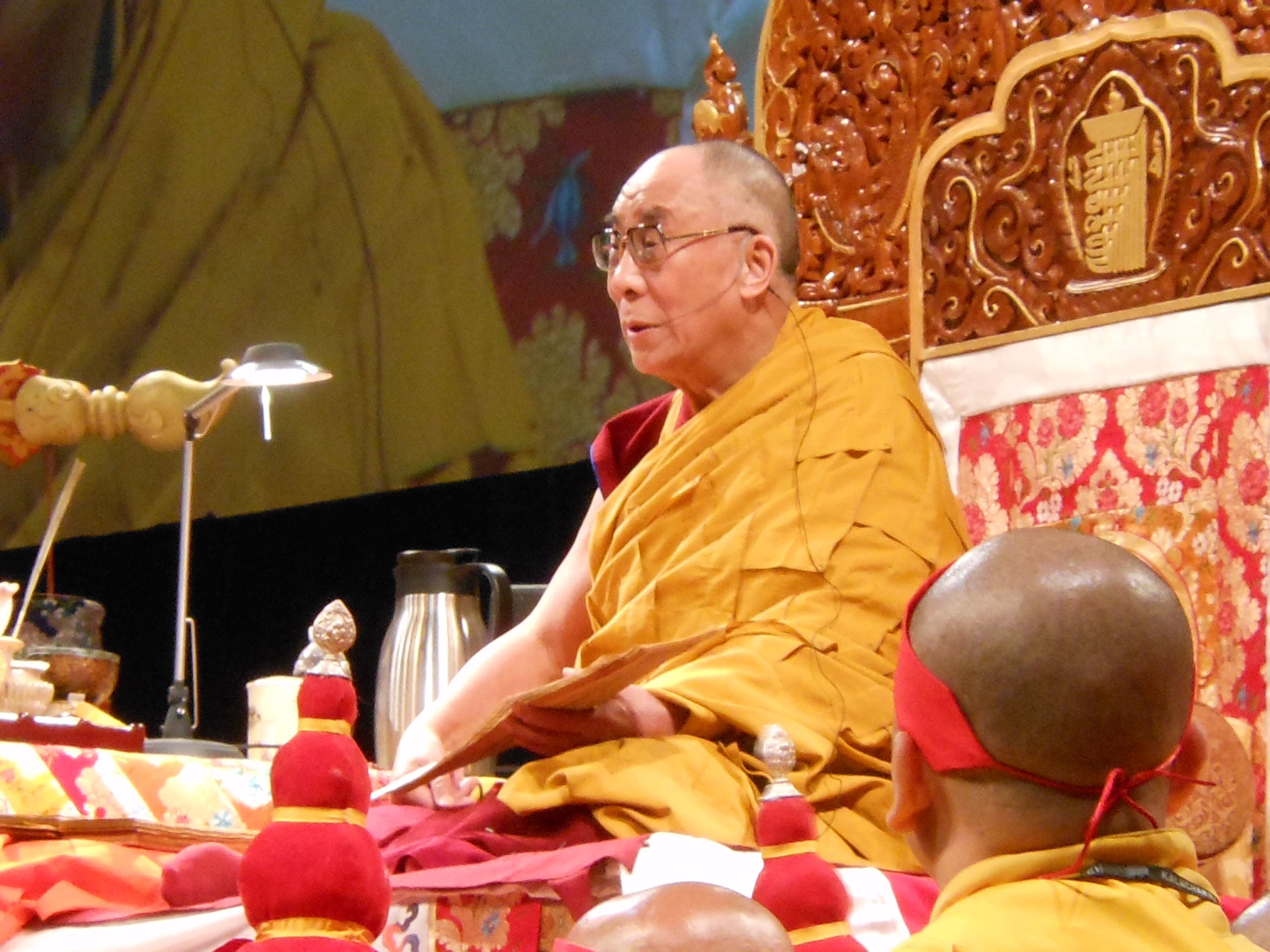
I have been privileged to see the Dalai Lama in person twice—at the Kalachakra for World Peace in July 2011 in Washington, DC, and at an empowerment in Long Beach, California, last month. Both encounters seemed otherworldly to me. He radiates a palpable energy that enraptures the audience. Perhaps the most winning thing about him is his readiness to laugh, especially at himself.

Early in the Kalachakra he spoke directly to the native Tibetan speakers in the audience…in English. After speaking for several minutes, he realized the fruitlessness of speaking in English to persons who understood only Tibetan and erupted in laughter. In Long Beach, he began chanting in Tibetan, only to halt after a few lines to confess, in English, that he was chanting the wrong prayer. He laughed uproariously at his mistake.

It was a marvelously joyous sound both times, a laugh you might expect to hear from someone hearing a joke for the first time in his life and not quite knowing what to make of the sensation. It swept through the crowd, infecting everyone who heard it, so that all were laughing with unrestrained joy.

That willingness to laugh at himself, to not take himself too seriously despite the very serious business he has to accomplish, sets the Dalai Lama apart. He is greatly revered by many, yet his brand of humility makes him seem accessible rather than lofty.

Personally, he awakens my awareness of the Buddha-nature inside of me. I don’t know that it ever seems more tangible to me, more capable of emerging, than when I am in the Dalai Lama’s presence. I would liken it to a pilot light in a stove, always on though barely flickering—until the Dalai Lama turns up the gas and it bursts into flame. Listening to his recorded talks, reading his books, the flame comes alive. In his presence, it’s a roaring inferno.

That experience prompts me to seek two things. One, to kindle that flame in my daily life so that the Buddha-nature in me shines forth and guides my path. Two, to recognize and become enflamed by that same Buddha-nature in everyone I encounter. Because it is present in everyone, at all times, in you, in me, always now, and not just in the Dalai Lama.

The Big Uneasy

Standard

I just got back from a trip to New Orleans on business, and it was a real eye-opener. This was not the first time I’ve been there since Hurricane Katrina devastated the city in 2005, but it was the first time I had ventured away from downtown and seen what Katrina hath wrought. Though I’ve heard many tales from friends and colleagues who live in New Orleans and were displaced by the storm, this was the first time I really saw the lasting damage that it had done to the populace.

Riding a public bus out to the Jazz and Cultural Heritage Festival, I saw building after building boarded up, uninhabitable even if someone wanted to open a business in them. Houses lay in ruins. Open lots were full of weed-choked debris. Though the touristy part of the city, downtown and the French Quarter, look relatively unscathed, the rest of the city and surrounding areas are, for lack of a better word, seriously scathed.

Barely a sentence seems to be uttered by Orleanians without mention of Hurricane Katrina. It might be tiresome if the hurricane’s terrible legacy weren’t so evident. Katrina changed everything there. Amazingly, the citizens and their leaders have done some amazing things in the almost seven years since. Entire neighborhoods have been rebuilt. A new school system (or, as educators down there prefer to refer to it now, a system of schools) was created from scratch essentially, and in the next two years every single school will be in a new and thoroughly reconstructed building. Yet something like 3 out of 10 residents have yet to return, and the homeless—always front and center in the past—seem to outnumber the tourists in some parts of the city. Nothing comes easy these days in the Big Easy.

The ghost-like nature of the boarded-up businesses and homes reminded me a lot of what I saw last year in Belize. The parallels are startling. Both are incredibly beautiful places full of lovely, warm-hearted people. Both are suffering from crushing poverty. Both have economies that are entirely too dependent on tourism, with little prospect for developing alternative sources of income. Both are populated with the husks of former houses and businesses. Think of it—Katrina turned New Orleans into a third-world country.

I came away from my few days in New Orleans moved by its plight, choked up by its pain, saddened by its losses, but encouraged by its resiliency. The people of New Orleans and its surrounding parishes need our prayers and energy as much as our business and resources, and we need for them to return to vibrancy, health, and prosperity in order to restore our universal shared energy and peace.

Dharma Digest, Vol. 1, No. 3

Standard

Some items recently posted to the Dharma Beginner page on Facebook, www.facebook.com/dharmabegin.

Love Thine Enemy

“Love is the only force capable of transforming an enemy into friend.” ~ Martin Luther King, Jr.

“I destroy my enemies when I make them my friends.” ~ Abraham Lincoln

I’d like to pass along one of the most valuable pieces of advice I’ve ever received: If you are angry at someone, if you think of them as your enemy, pray for them. You cannot remain angry at someone you pray for; someone you pray for… cannot long be considered your enemy. my own experience has borne this out.

Somewhere along the line I learned to practice putting myself in the shoes of those who would hurt me or make me their enemy. I usually need to let the hurt subside first, but when it has I can ask, “Why would they do this thing to me? What suffering must they be enduring that leads them to act in this manner?” Then I remember that everyone wishes to be free of suffering, friends and foes alike, and I pray that they will be free of suffering.

Sometimes I can manage to say those prayers with the sincerity of someone praying for a loved one or dear friend. Other times it takes a little more time, a little more distance from the pain. But once I pray sincerely for them, the hurt and anger melt away, and all that’s left is compassion.

How Do People Perceive Me?

“I don’t really care how I am remembered as long as I bring happiness and joy to people.” ~ Eddie Albert

I can be really hung up on how people view me now, as well what kind of mark on will leave on the world when I inevitably pass from this life. It amazes me that I still sometimes hesitate to do what is right because of thoughts about what “people” will think. Family, friends, coworkers, people… I wouldn’t know if I tripped over them – dear lord, what will they think? [insert dramatic shudder here]

In retrospect, it makes me laugh. There really should be some LOLs here. It seems so silly. Why should I care what it says on my tombstone? I’ll be dead. But in that moment, it still brings me up short. I think it’s right to take seriously what kind of world I leave behind, but not because of how I’ll be remembered for it. Because I believe it is my responsibility to leave behind as much love as I found when I entered it, and hopefully more.

Some Things I Hope We Can Agree On

“It does me no injury for my neighbor to say there are twenty gods, or no God.” – Thomas Jefferson

God, deity, higher power, energy, universal interconnectedness, angels, protectors, anti-gremlins (okay, I made that one up) – it doesn’t matter to me what you call it. Or if you don’t call it anything. Or if you don’t even believe in “it.” I don’t care, because I believe we don’t need any particular religion to connect and to agree on a few things:

1. We respect and care for others and ourselves
2. We show love and compassion to all
3. We seek to be happy, free from suffering
4. We are committed to growing ethically, spiritually, emotionally, etc.

I’m certain the list could be longer. But if you and I can agree on just one of those, that’s a great place to start building a friendship. I’d like to think that I could build such a friendship with each and every one of you.