Category Archives: Mindfulness

All I Do Is Talk Talk

Standard

“Better than a thousand hollow words, is one word that brings peace.” ~ Buddha

For much of my life I’ve been a talker—an incessant talker. When I was a kid, my dad would say I “suffered from verbal diarrhea.” Okay, he was still saying it when I was an adult. It was an apt description.

I could talk a blue streak. I was often quite funny, and occasionally squeezed in something meaningful. But 99 percent of what I said might charitably be called “babble”—and that might be a generous estimate of the worth of what I had to say most of the time.

It has taken me a long time to learn judiciousness when it comes to speaking—truthfully, I’m still learning. The process has moved along in stages—learning first to choose my words with care, to say much with few words. Then, learning that silence can speak volumes and is often preferable to speaking. More recently, learning to put speaking aside in favor of listening.

And I mean really listening, paying attention to the person speaking, being present for them and mindful of their words and their “non-words”—the things they’re not saying. What I used to think was listening was really me paying half-attention while figuring out the next thing that I was going to say once I could cut in.

I think that what the Buddha called “right speech” sometimes is best put into practice as no speech. I think that “I’m here for you, my friend” or “Go on, I’m listening”—and then being silent—is far preferable to any advice I might conjure up on a moment’s notice. Saying nothing sometimes says everything.

[Now you can listen to the Dharma Beginner blog. How cool is that? You can also subscribe to the Dharma Beginner podcast through iTunes. Dharma Beginner has entered the 21st Century…]

What a Difference a Year Makes

Standard

A little less than a year ago I wrote here about how I learned a life lesson about disappointment. I had traveled across the country to see the Dalai Lama for the first time and to participate in an initiation he was conducting. His physicians asked him to rest an extra day before traveling from Tokyo to California and as a result he missed the event. I spent one night angry, sad, and disappointed, and then spent the next day begin taught about humility, compassion, and real suffering and disappointment.

I knew right away what an important event that was, and one year later I can confirm that it was life-changing. For one thing, my practice shifted in tone and pace. I stopped being in a hurry to reach enlightenment. I began to focus on the present moment and where I was on the path at that time, rather than craning my neck to see what was coming up around the bend. I learned to appreciate what I was doing and experiencing at any given moment, instead of counting up the things I’d done or the things I wanted to do. I stopped trying to accumulate experiences and knowledge (though, to be honest, I haven’t stopped collecting books—my love of reading and learning continue to overpower my will and overtax my shelves).

I also started to get over myself. As deeply spiritual as my life has been at many times, both as a Christian and a Buddhist, I think I sometimes have been a tad too impressed with myself. Despite feeling somewhat lost exploring my path as a Buddhist, I still managed to inflate my spiritual self-importance. I was a bit too proud of the new spirituality I was developing, of the experiences and knowledge I was collecting like baseball cards and comic books (I should write sometime about The Green Lama).

A few months later, I had the opportunity to travel to Washington, DC, to attend the Dalai Lama’s conducting of the Kalachakra. I had difficulty trying to decide whether to go, so soon after the humbling I received in California. Was I succumbing again to the temptation to hit a spiritual home run? I seriously doubted my motivations at the time. In the end, I went, and it was a phenomenal decision.

When I received word late last year that His Holiness would be returning to Long Beach to “make up” the initiation he missed, and was invited by the event host to return free of charge, I wasn’t sure if I should go. The experience of the Kalachakra  would be very hard to top. And although Gaden Shartse Thubten Dargye Ling would be comping me the event tickets, I’d still have to pay for the flight, hotel, meals, rental car, and so on. I was ready to pass. Then my boss asked me to attend a conference that he and I alternate going to; this was supposed to be his year. The conference was in Las Vegas, practically all the way to California, it was the same week as the Dalai Lama’s return to Long Beach, and my employer would be paying for the flight out to Vegas. I realized I was being led back to California; who was I to kick against the goads.

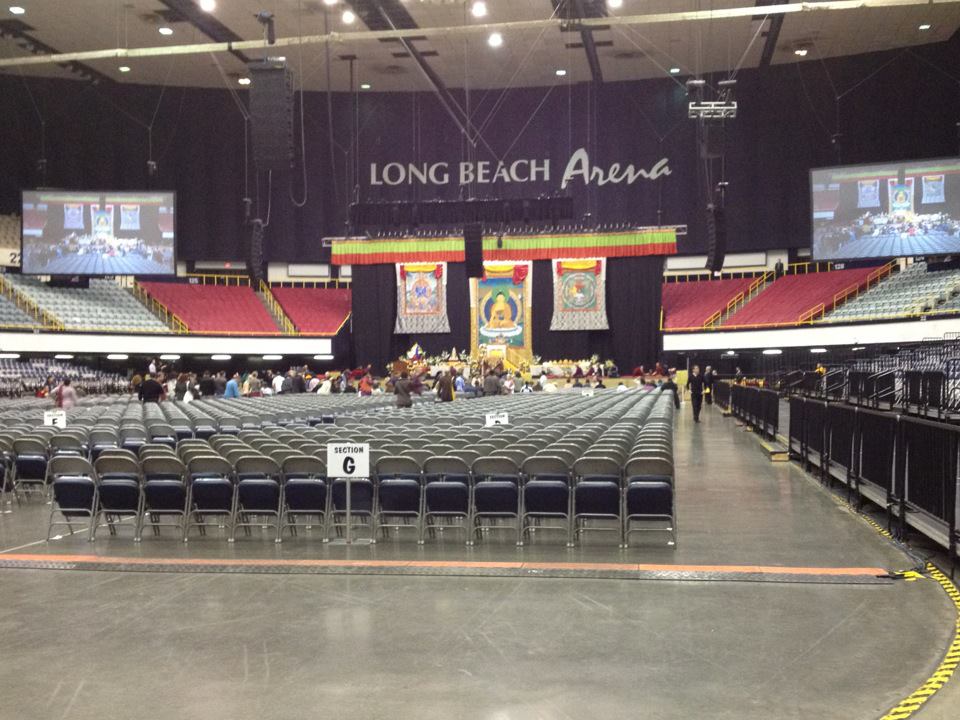
I got chills when I drove into downtown Long Beach Thursday evening, past the convention center where the Dalai Lama was supposed to appear last year, by the Westin where the humble Khen Rinpoche shamed me for my “disappointment” and the wise Robert Thurman put my feelings into perspective. When I checked in at the Courtyard, the desk clerk said he was switching my room to move me away from a large group of noisy young boys. My new room number was 619, which looks an awful lot like a yin-and-yang to me. I took it to be auspicious.

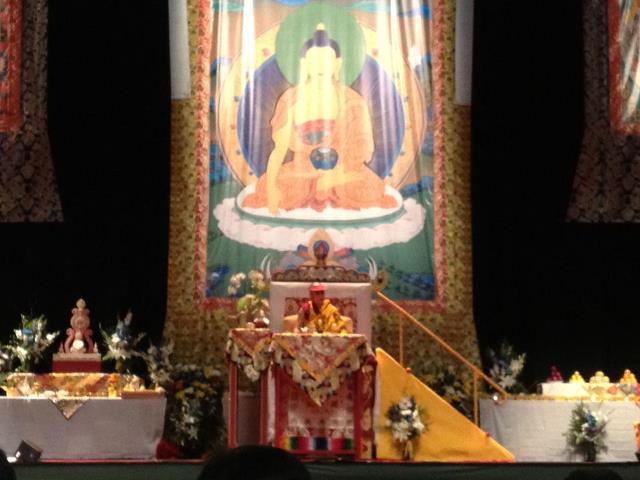
Two days later, as I type this, I am still processing the experience of see His Holiness again and participating in the initiation. I’ll write about it soon. In the  meantime, here are a few fuzzy photos I took with my phone. Hopefully, there are some better ones on my camera.

Namaste. Peace be yours.

Dharma Digest, Vol. 1, No. 2

Standard

Recent posts on the Dharma Beginner page at www.facebook.com/dharmabegin

Anger

“Holding on to anger is like grasping a hot coal with the intent of throwing it at someone else; you are the one who gets burned.” – The Buddha

Most of the time, when you succumb to feelings of anger, it eats you up inside and makes you sick emotionally and physically, but has little or no impact on the person with whom you are angry. I think that speaks volumes about the value (or lack thereof) of anger.

As many Dharma Beginner members pointed out, there is some value to anger as a motivator, something to prompt you to act to right wrongs. My former boss used to refer to that as “righteous indignation.” I can see what they’re saying, and I know from my own experience that anger can be useful. Personally, I prefer now to find my motivation in compassion, in generating bodhicitta.

Mindfulness of anger, as with awareness of any emotion, is paramount. To be aware of feelings of anger and be able to ask why are the keys to turning anger into something beneficial.

Enemies

“We cannot learn real patience and tolerance from a guru or a friend. They can be practiced only when we come in contact with someone who creates unpleasant experiences. According to Shantideva, enemies are really good for us as we can learn a lot from them and build our inner strength.” – The Dalai Lama

In the heat of the moment, and even for some time afterwards, it is so hard to recognize the lesson, let alone learn from it. So one of the ways in which I can measure my own progress is by observing how long it takes me to “emerge” from the unpleasantness and remember that unpleasant situations are learning experiences. Every once in a while I will remember as the unpleasant situation or experience is still occurring, and that brings joy and helps the unpleasantness to melt away.

On a side note, I find that people who act unpleasantly do not appreciate being thanked for the lessons that their unpleasantness provides, nor being told that they are a cross that you gladly bear. A word to the wise. 😉

Dharma Digest, Vol. 1, No. 1

Standard

A collection of recent posts on the Dharma Beginner page at www.facebook.com/dharmabegin

Laissez-Faire v. Micromanagement

“Life is a thing that mutates without warning, not always in enviable ways. All part of the improbable adventure of being alive, of being a brainy biped with giant dreams on a crazy blue planet.” – Diane Ackerman

Achieving a balance between laissez-faire and micromanagement is tricky. We accept that change is a fact of life, inevitable, and remind ourselves that the more detailed the plan we construct, the more likely it is to go awry. A life that follows strictly along a meticulously laid out plan is illusory.

Some degree of planning and preparation is necessary, though, isn’t it? Eating healthy requires real planning, I find. Being a vegetarian adds to the challenge. So where do we draw the line between obsessive attempts to control life and flitting about on the wind without any direction?

Perhaps it is at the point, still hard to discern, when “planning” one’s life becomes “attempting to control” it. (I say attempting, because I don’t believe we ever reach a point at which we are truly in control of life.) The practice I try to embrace is “flexible” planning—don’t make your plans rigid, but leave room for the unexpected (which, if past is prologue, really should be expected) and be ready to adjust. Expect things not to turn out as planned. Or, minimize your expectations, and thereby minimize disappointment. Not always easy for me to accomplish, but I’m working on it.

The Common Thread

“There is only one religion, though there are a hundred versions of it.” – George Bernard Shaw

I have long held an ecumenical view of religion, and never believed that my religion was any better than anyone else’s. My belief was that god, the higher power, whatever you call it, manifested itself differently to different people, in ways that were meaningful and understandable to them. But underlying all of the surface differences, they were constructed on the same basic foundation.

True, in their attempts to live out their religions, some people go astray and lose sight of the sameness of everyone, the inextricable connectedness of all beings. That does not, however, diminish the fundamental similarities of the various religions as they were originally conceived. One may try to establish that their way is the right way, their view is the correct view, but the things they do to distinguish themselves, to make themselves appear unique, in my opinion lead them away from the universal shared values of love and compassion.

Flexibility of Mind, Body and Spirit

“I am a man of fixed and unbending principles, the first of which is to be flexible at all times.” – Everett McKinley Dirksen

A yoga teacher was making a point about achieving balance by keeping flexibility and ease in poses, and avoiding rigidity. While the students were in tree pose (standing on one leg, other leg bent at the knee with the sole of the foot against the upper thigh of the standing leg, arms raised straight above the head), the teacher wandered the room, lightly poking the students on the shoulder. The students that were rigid, with locked knees and clenched jaws and gritted teeth, would teeter and drop out of the pose. The students that maintained ease in their pose, who were not overly rigid, teetered…but then regained their balance.

Have you ever been in a tall building and felt it sway? If buldings were not designed with flexibility that allows them to move in the wind, they would risk collapse. It’s not much different with us. If we go through life inflexible, unable to deal with anything less than our imagined ideal, we are destined for pain, suffering, and eventually collapse. The ability to adapt to the vicissitudes of life, to “roll with the punches,” to “bend in the breeze,” is essential to the presence of mind needed to progress toward enlightenment.

Human-ness and Saintliness

I read a quotation from the Dalai Lama’s brother about the Dalai Lama’s fascination with technology and invention as a child. His brother said the Dalai Lama’s favorite invention was super glue, second only to the invention of the stuff that removes super glue.
Reading that, I was reminded of the thing I love most about His Holiness: his human-ness. He is, without a doubt, an incredibly special person. And he is just a person, like you and me. He often refers to himself as just a simple monk, which he really and truly is. And yet, he also is so much more.

Two of my great spiritual inspirations have been Thomas Merton and Dorothy Day. Obviously, they were two amazing people. But what first attracted me to them was how they were both very human, with all the frailties that come with being human. I read each of their autobiographies (The Seven Storey Mountain and The Long Loneliness, respectively; I highly recommend them) as a young man and was amazed by how flawed Thomas and Dorothy were, how matter-of-factly ordinary, how much like everybody else. Their extraordinary accomplishments and the example they set for me were all the more remarkable in light of their human-ness. I couldn’t believe that these amazing, saintly people were little different from me. That never fails to encourage me

I Didn’t Seek It, But I’ll Take It

Standard

About a year ago I began this blog as one way to actively think about the path I was walking. For over 40 years I had walked a spiritually fulfilling path as a Christian, until realizing a couple of years ago that, somewhere along the line, I had stopped being a Christian and had become a Buddhist. Now I was walking an even more spiritually fulfilling path, though one far less familiar to me.

A lot of questions presented themselves to me and it seemed at times like I was feeling my way around in the dark. So I started blogging as part of my attempt to seek answers. It also occurred to me that I was probably not the only person seeking to answer those same questions. There might be a few people out there who would benefit from reading what I’m thinking, and it would be great to connect with those people and walk the path together.

Not long afterwards, I decided to create a page on Facebook with the same name, Dharma Beginner, as an extension of the blog and, primarily, to publicize its availability. My intention had been to post notices when new material was available on the blog, and perhaps the occasional quotation or link to a relevant online article. What happened next was wholly unexpected.

As of today, the Dharma Beginner page has 18,592 likes. That’s roughly 18,500 more likes that I would have predicted. So, an error of just 20109 percent, or slightly better than the accuracy of my NCAA basketball bracket.

This was not what I bargained for. This page has taken on a life of its own. In fact, I have been blogging only about once a month on average, but I am posting just about every day on the Facebook page. The regular visitors to the page seem to enjoy my blog but are obviously returning for other reasons given the infrequency of my blogging.

The regular visitors formed a beautiful little community right under my nose and without me noticing at first. Our virtual sangha, as I like to call it, has the same cast of characters as any in-person community. There are the gurus, as I think of them, the really experienced and knowledgeable people who can always be counted on to offer the perfectly apt quotation or to answer a baffling question. Thank goodness someone at the page knows something, because it’s not me!

There are the wallflowers who keep coming back but lurk in the corners, soaking up the experience while they shyly remain silent except for the occasional peep. Keep coming guys and gals and don’t feel pressured to speak up if you don’t want to. Just be there, because I love knowing that the page feeds you.

There are the hurt, those whose past experiences with organized religion have left them scarred and hypersensitive. My heart breaks for them and my compassion kicks into overdrive. I hope that they find some solace when they visit the page and are helped to recognize that happiness is within their grasp.

There are the debaters, ready to pounce on a point and beat it to a bloody pulp. I don’t know what I’d do without them, because they remind me that mine is not the only point of view and, quite often, their knowledge and passion puts me back in my place.

What there are, more than anything, are myriad people grateful for what they find at the page—which is amazing to me because I feel grateful for their presence. I am enriched by their many different voices and their common search for peace and happiness. I can’t imagine what my life would be like without them.

And this brought me up short recently. It began to dawn on me that I had a responsibility to the visitors to the page. I had been continuing my very low-key, minimally-responsible approach, posting the occasional quotation or article. But what happens when I go away, or simply am too busy to post? It doesn’t go unnoticed. People get worried about me. More importantly, people come looking for inspiration, a good word or two, encouragement, and see nothing new. I have given them a reason to expect such things, and sometimes I don’t deliver. Maybe they go away disappointed and never come back. Gosh, I hope not.

It occurs to me that, even though I can’t see the members of this community, it is a community nonetheless. One that I created and, therefore, am responsible for and to. If taking the Bodhisattva vows means that I have dedicated my life to aiding others in their search for enlightenment (and it does), then this is clearly one of the ways I have chosen to do so. Do I feel like I am upholding my vow in this regard? Not so much.

The issue has to do with much more than providing for new posts while I’m away on business or vacation, though. It has to do with taking risks, putting myself out there, and opening myself up to whatever may come. Just posting quotations and links to articles incurs very little risk. (Though, every time I refer to Chogyam Trungpa or Mother Theresa I set off a maelstrom! Can you say “polarizing individuals”?). My approach has been quite safe from criticism, quite safe from someone disagreeing or saying that I’m flat out wrong, quite safe from steering someone wrong and living with the consequences.

But more and more I find people reaching out for help publicly on the page and directly to me in private. Am I not responsible for helping them find an answer? I believe that, as the creator and maintainer of the page, I am. It is not a responsibility I sought, but I find that I am grateful for it and willing to embrace it.

I once heard one of my personal heroes and mentors, Bishop Walter Dennis, address a group of layreaders—people who read the Bible lessons to the congregation during church services. He emphasized the importance of preparation and taking the task of the layreader seriously by saying, “When you read the lessons, it may be the first time that someone has ever heard the scriptures, or it may be the last time they ever hear them because they will enter heaven before attending church again.” What an awesome responsibility! When it comes to this Facebook page, is it really any different? It could be the first time a visitor has ever read the Dharma or it could be the last time. Do I not owe it to them to provide something worthy of such occasions? I believe I do.

The denizens of Dharma Beginner may have noticed recently that my offering of quotations has come with some additional thoughts attached. That is me putting myself out there, expressing what the quotation says to me. That is me taking a little risk by exposing what I know and—more often—what I don’t know, opening myself up to disagreement, to the possibility that I will offend, to the chance that someone will read what I wrote and “unlike” the page, never to return. That would pain me indescribably, but I believe the potential gain, for the visitors and for me, to be far greater.

For a time now, I have been talking with my therapist about feeling called to do something different with my life, to set aside what I do now professionally in order to pursue a career helping other people spiritually. It’s a scary proposition: I’m very good at what I do now (as a researcher and author on government finance), I’m respected and well-known nationally within my particular industry, and I make a decent living. I have no idea if I’d be any good at being an author and speaker on spiritual matters, or whether I could support myself and my family doing so. So I’ve decided to take a small step in that direction, a toe dipped in the water, and the Dharma Beginner page is the base of operations from which I’m going to start doing that. I’ve been using the Twitter account associated with the page (@dharmabeginner) more often. I’m thinking about writing some things to submit to other web pages and magazines. I hope you’ll stick with me and continue to lend me your thoughts and opinions and support and friendship. Because it means so very much to me, and because I am so very grateful for it. Thank you.

Happy Lent!

Standard

Happy Lent!

Granted, it’s not the happiest of times in the Christian calendar. The Lenten tunes in the Episcopal hymnal are singularly dirge-like. “Forty days and forty nights, thou wast fasting in the wild…” Zzzzzzzzzz…

But growing up, I learned to actually “celebrate” the season, much as I would celebrate Christmas or Easter, though with obviously different undertones. Whereas one might celebrate the latter two seasons joyously, Lent is perhaps more appropriate celebrated quietly, piously. It is a time, nonetheless, for celebrating life and the divine spark that inhabits it. There are different aspects of our spirituality, of our relationship with our higher power, but all are worthy of being celebrated and experienced to their fullest.

I was taught that, when giving something up for Lent, one should choose something that is truly a sacrifice. For instance, I would never have the slightest problem giving up cauliflower. Giving up sweets or television, though, truly felt sacrificial (at least from my admittedly middle-class, suburban perspective). Eating fish on Fridays felt like the cruelest form of torture (especially if the fish were in a form other than sticks!).

I am grateful for the parish priest who challenged us to make our sacrifice permanent—to consider Lent not a temporary exercise, but the beginning of a lifelong habit. Even more importantly, in my mind, I learned to take something on during Lent, in addition to or instead of giving something up. One might institute a new healthy practice, like walking or meditating, incorporating it into their daily life during Lent and then continuing well beyond Easter morning.

Toward the middle of the Easter Vigil, the church service that takes place on the eve of Easter Sunday, it is traditional for worshippers to ring bells during the singing of the Gloria. It is a part of celebrating the resurrection of Jesus, signaling that moment in the proceedings as the transition from Lenten sobriety to Easter gaiety. (Hooray, we can sing “alleluia” again!) It is tempting to view the raucousness of the ringing bells and booming organ as a celebration of the end of dreary Lent but, in fact, it is a celebration of Christ’s victory over death and the beginning of new life.

The notion of Lent as a time to improve upon our spirituality is one that we can seek to emulate, regardless of spiritual or religious affiliation. This is a good time for all of us to consider doing something new, or something more, or something differently, with an eye toward making a permanent change for the better in our lives. Ring your bells, toll out the news that you are rejuvenated and ready to pick up the pace as you walk the spiritual path.

Snowshoeing Meditation

Standard

Thich Nhat Hanh has his niche, walking meditation. (Okay, his “niche” is as wide as the Grand Canyon, but humor me.) Now I’ve found my niche, snowshoeing meditation.

I went snowshoeing for the first time today, on a crisp, sunny morning. (By crisp, I mean cold enough that exposed fingers could be snapped off like icicles hanging from your gutter.) The snow was nearly pristine, save for a handful of human and dog footprints (and the occasional patch of yellow snow) and a couple of bicycle grooves. The sun was bright, if not warm. There was nary another soul to be seen.

Perfect conditions for meditation. Snowshoeing meditation is going to take off. Get in on the front end before the meditation trails fill up with meditators. Because they will, when people hear about the rare insights that I found while trudging through the powder.

Humility

Mortal embarrassment is a reasonable approximation of humility. I was no more than a tenth of a mile into my first snowshoe journey when I stepped on one snowshoe with the other snowshoe and tumbled head first, ass second. Laying on my stomach, snowshoes tangled behind me, snow in my face, I benefited from the unique perspective of looking up at the rest of the world. Lest I think the experience a fluke, I repeated it misstep for misstep a mere five minutes later. No mistaking the message: This is the way I ought to look at the world.

Impermanence

Barely a day ago, this path along the Tarrytown reservoir was bare, perhaps sporting the occasional dead leaf. Late yesterday it was a pristine boulevard of unmarked snow. With the passage of each hiker, dog walker, squirrel, deer, child on a mountain bike, and other wild animals, the path changed. Sometimes slightly, imperceptibly; sometimes significantly, unmistakably. No doubt, as the day progressed, more and more beings passed through, experiencing a different path from the one I did, and altering the path again. Tomorrow it promises to be warmer, there may even be some rain, and the path will change again.

Attachment

Fresh snow resting atop tree branches is a lovely, peaceful sight. There was plenty of evidence of the damage last year’s major snowstorms did, however, with the woods populated by jagged stumps of trees that had snapped in two from the weight of the snow. Occasionally, as I passed a younger tree bending under its snow coat, I would poke a branch with one of my walking poles. Freed of its burden, the tree would snap upright again. The things that we attach ourselves to, or that attach to us, can weigh us down as well, bending us over under their accumulation. Meditation, acts of compassion, and other practices are needed to shake those attachments off and free us to walk the path uprightly.

Mindfulness

As I neared the end of my snowshoe trip, I was beginning to draft this blog post. That’s the way I generally write. By the time I sit down to type, much of what I intend to write is already in my head. That’s neither good nor bad, but it’s definitely not conducive to snowshoeing. I guess I had already forgotten the lesson of face planche-induced humility. My snowshoes tangled again, nearly dumping me on my melon once more. I literally heard the words in mind, Pay attention! I had stopped being mindful of the main task at hand, putting one snowshoed foot in front of the other, rather than on top of the other. I was grateful for the lesson, and thankful that it didn’t take another face full of snow to learn.

So, am I right? Snowshoeing meditation is going to be all the rage, right? Hello?